I am a postdoctoral researcher at the Institute of Physics, Johannes Gutenberg University Mainz, working with Friederike Schmid on the statistical physics of block copolymer self-assembly and biomolecular condensates. Broadly, I am interested in how structure emerges in soft and living matter, both when it self-assembles at equilibrium and when it is driven away from it.
My approach combines field-theoretic methods (self-consistent field theory, hybrid particle/Ginzburg–Landau models) with particle-based simulations (Langevin dynamics, lattice Boltzmann hydrodynamics, kinetic Monte Carlo).
My current work centers on three questions: what stabilizes ordered block copolymer phases and the topological defects within them; how passive/active dopant colloidal particles steer the pathway of polymer vesicle formation; and what sets the size, shape, and organization of membraneless compartments in RNA–protein phase separation, where active transport and other non-equilibrium processes can select length scales that thermodynamics alone cannot.
Before Mainz, I completed my PhD in Physics with Gary W. Slater at the University of Ottawa, working on single-molecule transport through nanopores: how molecules are captured, why orientation and hydrodynamics matter for stiff polymers, and how pulsed fields combined with nanofluidic ratchets can separate DNA by length.
🔬 Research
📝 Publications
Active Matter & Biomolecular Condensates
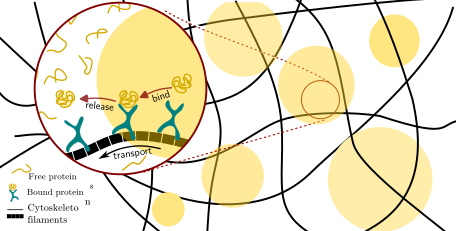
Active Transport as a Mechanism of Microphase Selection in Biomolecular Condensates
Le Qiao, Peter Gispert, Lukas S. Stelzl, Friederike Schmid. (2026). Phys. Rev. Research, accepted.
- Using a minimal diffusion-transport model together with linear stability theory and three-dimensional simulations, we show that motor-driven active transport along cytoskeletal networks can arrest the coarsening of biomolecular condensates, selecting a finite droplet size tunable from hundreds of nanometers to microns. This mechanism also drives shape transitions from spherical to cylindrical condensates, pointing to a route for engineering programmable active emulsions.


Block Copolymer self-assembly
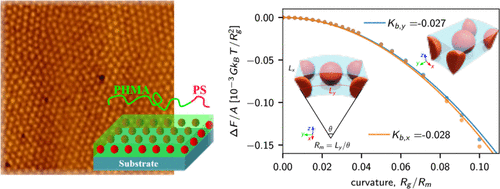
Stability and Elasticity of Ultrathin Sphere-Patterned Block Copolymer Films
Le Qiao, Daniel A. Vega, Friederike Schmid. (2024). Macromolecules. 57(9) 4629-4634.
- We use self-consistent field theory (SCFT) to investigate the elastic response of sphere monolayer films with respect to in-plane shear, in-plane extension, compression deformations, and bending. We demonstrate that the bending constants are found to be negative, indicating that free-standing block copolymer membranes made of only a sphere monolayer are inherently unstable above the glass transition.


Particle-Mediated Tuning of Defect Stability in Lamellar Block Copolymer Systems
Le Qiao, Daniel A. Vega, Friederike Schmid. (2026). arXiv:2608.30981.
- Using a hybrid particle/Ginzburg–Landau model with finite-size scaling, we study how colloidal particles change the formation energy of dislocation defects in lamellar block copolymers. Homogeneous particles increasingly stabilize dislocations as their size grows, while balanced Janus particles instead raise the formation energy, offering design rules for controlling defects in particle-doped films.

Nanopore Translocation
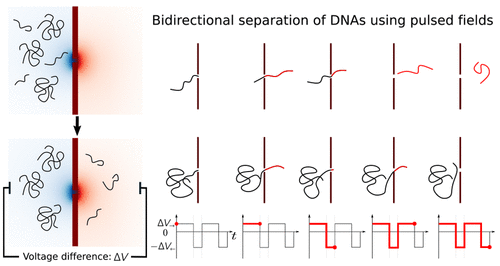
Ratcheting Charged Polymers through Symmetric Nanopores Using Pulsed Fields: Designing a Low Pass Filter for Concentrating Polyelectrolytes
Le Qiao, Kai Szuttor, Christian Holm, Gary W. Slater. (2023). Nano Letters. 23(4) 1343-1349.
- We present a new concept for the separation of DNA molecules by contour length that combines a nanofluidic ratchet, nanopore translocation, and pulsed fields. Using Langevin dynamics simulations, we show that it is possible to design pulsed field sequences to ratchet captured semiflexible molecules in such a way that only short chains successfully translocate, effectively transforming the nanopore process into a low pass molecular filter.

Capture and Translocation of a Rod-Like Molecule by a Nanopore: Orientation, Charge Distribution and Hydrodynamics
Le Qiao, Gary W. Slater. (2022). Phys. Chem. Chem. Phys.. 24, 6444-6452.
- Using hybrid Langevin dynamics and lattice Boltzmann simulations with P³M electrostatics, we study how the charge distribution along a rod-like molecule shapes its capture and translocation through a nanopore. Rod orientation evolves asymmetrically between capture and escape despite symmetric field lines, and rods launched near the wall are captured faster because they align with the local field — while the orientational capture radius we proposed earlier remains valid once electrohydrodynamic interactions are included.

Full Publication List
-
Le Qiao, Peter Gispert, Lukas S. Stelzl, Friederike Schmid, Active Transport as a Mechanism of Microphase Selection in Biomolecular Condensates, Phys. Rev. Research, accepted (2026).
-
Le Qiao, Daniel A. Vega, Friederike Schmid, Particle-Mediated Tuning of Defect Stability in Lamellar Block Copolymer Systems, Preprint, arXiv:2608.30981 (2026).
-
Le Qiao, Daniel A. Vega, Friederike Schmid, Stability and Elasticity of Ultrathin Sphere-Patterned Block Copolymer Films, Macromolecules, 57 (9), 4629-4634 (2024).
-
Le Qiao, Marios Giannakou, Friederike Schmid, An Efficient and Accurate SCF Algorithm for Block Copolymer Films and Brushes Using Adaptive Discretizations, Polymers, 16, 1228 (2024).
-
Le Qiao, Kai Szuttor, Christian Holm, Gary W. Slater, Ratcheting Charged Polymers Through Symmetric Nanopores Using Pulsed Fields: Designing a Low Pass Filter for Concentrating DNA, Nano Lett, 23, 1343-1349 (2023).

-
Le Qiao, Nicholas Ilow, Maxime Ignacio, Gary W. Slater, An Empirical Method to Characterize Displacement Distribution Functions for Anomalous and Transient Diffusion, Physica A, 604, 127676 (2022).

-
Le Qiao, Gary W. Slater, Capture and Translocation of a Rod-Like Molecule by a Nanopore: Orientation, Charge Distribution and Hydrodynamics, Phys. Chem. Chem. Phys., 24, 6444-6452 (2022).
-
Le Qiao, Maxime Ignacio, Gary W. Slater, An Efficient Kinetic Monte Carlo to Study Analyte Capture by a Nanopore: Transients, Boundary Conditions and Time-Dependent Fields, Phys. Chem. Chem. Phys., 23, 1489-1499 (2021).

-
Le Qiao, Gary W. Slater, Capture of Rod-Like Molecules by a Nanopore: Defining an “Orientational Capture Radius”, J. Chem. Phys., 152, 144902 (2020).

-
Le Qiao, Maxime Ignacio, Gary W. Slater, Voltage-Driven Translocation: Defining a Capture Radius, J. Chem. Phys., 151, 244902 (2019).

–>
📖 Educations
- 2016.09 - 2021.06, PhD, Physics, University of Ottawa, Ottawa, Canada.
- 2015.01 - 2016.08, MPhil, Biological Physics, The University of Manchester, Manchester, UK.
- 2010.09 - 2014.06, BSc, Material Physics, China University of Petroleum (East China), Qingdao, China.
💬 Selected Talks
- 2024, Stability and Elasticity of Ultrathin Sphere-Patterned Block Copolymer Films, DPG spring meeting, Berlin, Germany
- 2023, Size and topology-based separation of charged polymers using nanopore translocation with AC fields, Ring Polymer Dynamics Workshop, Prato, Italy
- 2022, Ratcheting charged polymers through symmetric nanopores using pulsed fields: Designing a low pass filter for concentrating DNA, DPG Spring Meeting, Regensburg, Germany
- 2021, Capture of semi-flexible polyelectrolytes by a nanopore: a Lattice Boltzmann Simulation Study, APS March meeting, Online
- 2020, Capture and translocation of a rod-like dsDNA by a nanopore: a Lattice Boltzmann simula- tion study, APS March meeting, Online
- 2019, Capture and translocation of a stiff oligomer by a nanopore, APS March meeting, 2019, Boston, MA, US